

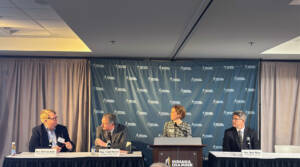
 The following is a transcript of the top questions and answers from the Indiana Chamber’s 2025 Legislative Preview panel on Monday. Panelists included: Indiana House Speaker Todd Huston (R-Fishers), Senate President Pro Tem Rod Bray (R-Martinsville) and House Minority Leader Phil GiaQuinta (D-Fort Wayne).
ECONOMIC DEVELOPMENT
With economic development in recent years having focused heavily on capital investment, is this the right metric going forward, or should the state consider other measures to ensure balanced growth?
Bray: “I think so. I think we should probably consider (it); it’s a nice time with the transition from the governor’s office to revisit that and take a look at what makes most sense for the state of Indiana. We have had, and Governor Holcomb’s done a fantastic job over the last several years in bringing in lots of capital investment, but it is a fair question to decide or (ask), ‘Should capital investment be the litmus test or should we look at the jobs and the industries that we’re attracting here?’ And I think we can need to probably take a little bit of a look at that, look at the jobs and the skillset of those jobs that we’re bringing in. So I think, like I said, we’ve had a great story to tell over the last several years, but maybe taking a look at how we continue to try to bring in business and investment. Taking a fresh look at it makes a lot of sense.”
Huston: “Look, I think it is the right metric because so much stuff builds right off of it … I think what we try to do is say it’s not just a quality number of jobs, it’s the quality of jobs, what the average pay is that really matters in all this. I think one of the things that happens that people just forget or don’t want to pay attention to is that when you see a company make a $3-4 billion investment, typically that is about (an impact of two or three times that) when you add in the supply chain and everything that happens around it. So it’s not just the investment that takes place and where the investment takes place, but it’s also the investment that happens around it.
“And that’s what I think is so cool about what’s taking place across Indiana is literally you have that if you go up and you look at Lilly’s investment, you look at AWS’s investment, if you look at Google’s investment, if you look at Stellantis’ investment … I mean these are all big capital investments, high paying jobs and a huge network of supply chain working around them. So we should never ever forget that. Ultimately we want to make sure we have to track and prepare the workforce for these new jobs, but I think occasionally people will get focused on just that one project and that one number and not forget that you’re really building an ecosystem all around that and I think that’s what, if you go up to northeast Indiana, north central Indiana, I mean literally you could pick any place across southeast Indiana, you could pick any place across the state where you see big, big investments being made and what will happen around the supply chain around it I think is fabulous.”
GiaQuinta: “Yeah, I always have said and believe that education is really the ultimate path forward to economic development. We need just to continue to invest in education, obviously K-12. Then in our higher institutions as well, businesses are going to go where there are workers, where there’s trained workers, where there’s workers that do the jobs that are available and when we do talk about metrics and which ones should be used, it doesn’t necessarily have to be … you asked about capital investment. Some other metrics I think we should probably take a look at are (these creating jobs)? What type of tax revenue are they generating? What are the jobs that we are creating? Are they the type of jobs that can sustain workers here in Indiana? Do they pay pretty good income? Do we want to continue to look at biotech jobs and research jobs, things like that. But again, as I circle back to what I said earlier, education is a key and we want to make sure that no matter what we do in this budget year, that we’re continuing to invest in our education system here in Indiana.”
EDUCATION
Strengthening the pipeline from K-12 to the workforce has been a legislative priority for the General Assembly as well. What challenges remain, and how can the state further align education systems with the needs of Indiana’s evolving industries?
Huston: “Look, I think there are challenges, but I want to first start with successes. I mean I think if you go around the state right now, you can go to places whether it’s in the high school level where high schools are talking to employers in their community and making sure that they’re preparing kids for the jobs that are available in their communities. You go to Ivy Tech and you see the Ivy Tech partnerships that are taking place in our state and again where you’ve got alignment between workforce and business needs. I think that is incredible. Then obviously work being done at the four year schools, so I think I’m actually the last couple of years I’ve been really, really encouraged. I think particularly the K-12 level, you’ve seen a lot of the K-12 leaders begin to recognize and make the necessary changes to adapt to really thinking about how they are preparing kids for the workforce that again, 47% of our kids aren’t going to go to a two- and four-year college when they leave in Indiana high school.
So, we have to make sure they have the credentials, the certificates and the skills to be able to be productive citizens when they leave and I think you’re seeing that taking place more and more across the state. So that’s I think something I’ve been encouraged by. I think the challenge sits with all you. I mean frankly we need more businesses to step up and more businesses to provide opportunities to kids, internships, apprenticeships, those types of things. I think we have to, we can’t rely on the workforce to show up at our door. We have to go get our workforce and I know there are a bunch of groups that are actively engaged in that right now and I’m grateful and thankful for each of ‘em, but that right now is the greatest challenge is just making sure these kids understand what jobs are available to, they’ve got opportunities and they get the experiences they need to be productive when they leave Indiana High School, but I think right now I really like the trajectory we’re on.”
Bray: “I’ll completely agree with the speaker, like the trajectory we’re on as well. The other thing I’ll highlight is something that the Chamber and lots of folks have been working on over the last couple of years is to try and get an apprenticeship program going on that we need. Obviously our public schools and universities but also employers out there kind of leaning into that and I think that’s something that’s going to really be extremely helpful to our kids and as they try and grow from high school into the workforce and learn some skills and we just need employers to embrace that and begin to engage in that apprentice system as well.
GiaQuinta: “Better trained, educated kids lead to a better workforce and that includes more a universal pre-K program if you want. There are so many problems that we can alleviate if we just have a more robust pre-K program in this universal pre-K here in the state of Indiana. And obviously when we talk about trajectory of where things are going, I don’t think we’ve done really a very good job of making sure that we’re getting more kids into college. We’ve seen that declining. We talked about trying to keep more college students here. I think the number I saw, I think 65% of our college grads are staying in Indiana. I don’t believe that’s high enough. We need to work to make sure those kids are staying here. I like to sort of speak from experiences too where I come from in Fort Wayne from Fort Wayne Community schools.
I think they’re really doing a nice job by the way of trying to work with students as they enter freshman year and sophomore year to think about what careers they may want to take and aligning them those things that they’re learning in high school to those career paths. … I think we did better last year with the 21st Century Scholars program, things like that, making sure that kids can go on to college and if they don’t, I want to make sure that they also have the training necessary in high school and get them aligned up for a job as they leave high school, whether it’s in the trades or whatever they choose to do or a two-year degree with Ivy Tech. So there are some things that we can certainly work on. I do think we aren’t always going in the right direction and that’s incumbent on us as legislators to turn those things around.
ENERGY
Is the current policy landscape sufficient to secure an adequate and reliable energy supply for Indiana’s growing industries, or are policy changes needed to address potential gaps and price competitiveness?
Bray: “We’ve got some challenges in the energy space. I think obviously if you look around and given the capital investment and the investment in the state of Indiana, we’ve seen over the last few years in particular in some industries like data centers that really is strapping the capacity the state has right now and that capacity is beginning to limit us, has already begun to limit us, so we’ve got to take a really close look at that to make sure that whatever we do, whatever policy that we propose and move forward with, it helps to expand that capacity because it will, I think, continue to limit us. The other thing that has been frustrating to watch over the last 20 years really is a slip in the competitiveness in Indiana when it comes to utility costs. Back in 2003 or 2004, we were third or fourth in the nation (in terms of) cost of energy or cost of electricity. Now we’re north of 30 somewhere and so we’re moving in a bad direction. Very complicated I think to figure out exactly why that is, but our policies need to reflect the need to adjust those things.”
GiaQuinta: “When you talk about growing industries, I kind of figured you were talking about data centers and we’ve got Google constructed up in Fort Wayne and I know there have been concerns about whether or not we have the necessary energy, things like that to keep Google going up there. I believe we do. I know there has been some conversation going forward that we’ll be talking about in the upcoming session … How do we make sure Google doesn’t just up and leave? I don’t think they will, but how do we make sure that the ratepayers aren’t on the hook for any investments that we see going into places like a data center like Google? Google doesn’t necessarily create a lot of full-time jobs. I think they’re maybe around a hundred, but certainly a lot of construction jobs are going to be building out I think for over the next five to 10 years. I think I heard, so there’s two types of jobs that are construction and then full-time, but obviously we want to make sure that we do have enough energy. I believe that we do, but this is something obviously to keep an eye on and make sure that rate payers aren’t on the hook for any type of this type investment where they could be for in case someone went up and leave.”
Huston: “Again, this is an extraordinarily important issue. We have a great opportunity in the state of Indiana right now, you’re seeing it across the state about welcoming large energy users. I’m extraordinarily optimistic. We can meet all their needs. I think the energy companies know how I feel about it. I have a great expectation they will and I don’t want to hear differently, so figure it out. The fact of the matter is I’m energy agnostic, I don’t care whether it’s coal, natural gas, solar, wind, nuclear or mice running in cages. It doesn’t matter to me. I just want that energy. Senator Bray noted it needs to be cost-effective and we need to look at those models to make sure that’s the case too. I do feel like, look, I think we’re going to have a federal partner in energy that we haven’t had and an energy policy at the federal level that’s based upon reality and not theory, and I think that will be helpful as we get into these discussions.
“But look, we sit in the middle of the Midwest. I want every data center that we can get in the state of Indiana. These are huge economic opportunities, great for locals from a local tax base perspective. As I mentioned, a huge supply chain that grows off of that around it and the fact is we’re in a spot right now where we’re awful attractive to businesses and that’s because a lot of work that people in this room have put together and we shouldn’t have energy policy be a hindrance to that. So we need to figure it out. We need to probably build some more capacity in the state. I think we’ve got companies that are in the process of doing that and we need to facilitate making that happen.”
CHILDCARE
Many of our members have identified childcare accessibility as a significant barrier to workforce participation. What policy changes are needed to expand capacity and improve affordability?
GiaQuinta: “It is expensive. And it’s funny because when we talk about economic development and what things impact economic development here in the state, childcare is really one of those and it’s something that House Democrats I know have talked a lot about in prior sessions, so we’ll continue to work on that. I’ve talked to some businesses that are in Fort Wayne that are located in certain clusters and they would love to be able to combine services and really come together as a group. What incentives would there be for them to be able to do that? Obviously, we’ve looked in the past with regards to childcare centers and I know obviously we have some regulations there and we don’t want to make them less safe, but if we continue to work on those types of things with regard to childcare centers so more folks can get into the business, that may help more competition to help bring down some of those costs.”
Huston: “I’m really glad Leader GiaQuinta had talked about regulations because the fact of the matter is this is: When the government gets in the way and in the interest of safety and quality and a whole lot of things I know we all care about, we created a marketplace where it was almost impossible for someone new to enter into it. And so then we got a terrible, terrible constraint of supply … I mean it’s almost like some of these families are paying the equivalent of multiple years of college tuition to even take care of their kids. We began this process last year really trying to look back at those regulatory environments. How do we create more capacity? How do we create more opportunities for people to start childcare businesses, both childcare centers and home-based childcare? …
“This is a huge issue for every company I talk to and every person and particularly a young family. I will say this, I think it is incumbent that if you’re a company, you should not be looking in the state of Indiana to solve your childcare needs. If you think you have childcare needs that are preventing you from having the workforce capacity you need, I would suggest you figure out how to do it instead of looking at for us to do it for you.”
Bray: “Ditto what the speaker said.
One of the major challenges to providing quality childcare is access to workers with degrees in early learning. While employers can help with some other aspects of it, is that something you see the state getting involved with to help?”
Huston: “I’ve had conversations, I ‘m sure other people have had conversations with Early Learning Indiana and others about this specific issue. I think we need to take a look at those requirements and what we’re asking people. I also think there’s opportunities for more robust programs to help people through that licensure process. And I know people are thinking about that. But again, I think we need to begin to continue to ask ourselves, ‘Do the regulatory requirements around licensing match what the needs are?’ And sometimes we just keep expanding, expanding, expanding it and the next thing you know, I mean you’re not going to attract somebody with a master’s degree in childcare with the wages that they’re going to make. So we have to acknowledge that and think about that and figure out what do we really need the requirements to be and adjust those accordingly.
TAXATION
Following the two-year tax task force, what are the critical takeaways, and what will be the most important considerations to ensure Indiana’s tax policies remain competitive for both businesses and individuals?
Bray: “The first takeaway that I would point out is that I think we found after this exercise that Indiana is extremely competitive in its tax structure. Grateful to find that and I’m not entirely surprised about it, but I think that’s a good part of the story and worth telling. Having said that, I think the group kind of focused toward the end more on property taxes than anything else and as I said at the start, we have some challenging, protracted problems that we’re going to work on this year. Property taxes is one of them; I don’t know that you’ll see really big changes happen this year. Maybe some tweaks to help people feel a little less of a pinch than they have. I think any elected official legislator across the state can probably tell you the issue they’ve had addressed with them more than anything else is property taxes over the last year or two. And so you’ll see maybe some changes to that. Maybe some opportunities to increase local government’s ability to do local income tax as well and perhaps some larger reforms moving down the road that are going to be more complex and take longer to address than just one legislative session.”
GiaQuinta: “When it comes to the individual income tax, I know it’s at a rate pretty competitive with our fellow states … I think it’s pretty stable, probably just need to frankly keep it the way it is. I do know there’s some issues with regards to property taxes that we’ll certainly take a look at. It’s just we always have to keep in mind too that whenever we fool around with these things that we are affecting local governments and their ability to do the things that they have to do. And so there will be definitely a call for any sort of replacement revenue if we’re going to take away from one, how do we replace it to make sure local governments can function the way they need to. And this is something I’ve always thought and always said that when it comes to taxes, certainly want to keep them all low, but I think if you can have a balance of taxes that kind of hit everyone frankly and we can keep those low…
“So we’ll obviously be working our ways and means group will be working with yours as well as Mr. Speaker to see what we can do there, but those are the only things that I would throw out there as kind of caution to when we start talking about taxes.”
Huston: “I agree with Leader GiaQuinta. The fact of the matter is you do want to find a balance. We just don’t have a competitive income tax. We have a very good income tax, so we continue to reduce that. We will continue to reduce next year. So it’s one of the reasons why Indiana’s a great place to make investments. I think we’ll look at the property tax issue as the leader said and Senator Bray said, we’ll need to be conscientious of the whole host of factors that impacts …
“… And so the fact of the matter is we are attracting people, we’re attracting investment. Part of the reason we’ve done that is a lot of the reason we’ve done that is we’ve got a great tax system, a stable tax system or a liable tax system along with a great regulatory environment. And I think you should always be, and I appreciate the work of Senator (Travis) Holdman and Chairman (Jeff) Thompson, they continue to look at all this. We’re doing a lot of things we can certainly tweak and make some changes on things that we think maybe are preventing us from being even better, but we’re building off a really good foundation.”
CIGARETTE TAX
The Chamber has long advocated for a $2 per pack increase in the cigarette tax, with the House passing such legislation multiple times. What are the prospects for the Senate to consider this issue in 2025?
Bray: “More likely this year than in the past. I think that the studies have shown if you increase it, it will help people either not start smoking or vaping but maybe also get off of smoking or vaping; both of which are great pieces of public policy. And the other added feature this year is that we’ve got a Medicaid challenge financially – started out $984 million missed forecast that we discovered last year. So, there’s some added motivation to maybe do this tax as a result of that to try and help shore that up a little bit. At the end of the day, our caucus will decide if we’re going to go with that or not.”

